Posted Aug 18, 2026
The Lamps Are Not the Old Part
Seattle's first street lighting burned coal gas a few blocks from here in 1873, delivered through hollowed-out cedar logs.
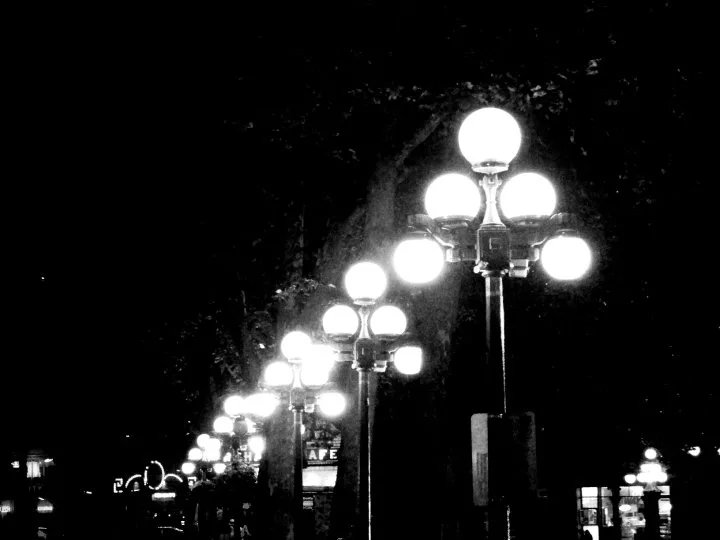
Seattle’s streets were first lit on New Year’s Eve, 1873. Coal gas, converted from Eastside coal, running out to five streets and forty-two private houses from a plant on the tide flats a few blocks from where I stood for this frame. The pipe was hollowed-out cedar logs. That is not a folk story someone invented later; that is how the gas actually got under the city.
The lamps here are not those lamps. Nothing from that first works survived, and the company’s own records went up in the fire of 1889. Electricity took the job instead. City Light raised an ornamental lighting system in 1909, and the globe standards around Pioneer Square today are replicas of that generation, most installed in the 1970s, most now running LED behind the old glass.
Count it forward and the light in this photograph is three technologies removed from the gas: coal, then filament, then diode. The pole is a copy of a copy. Only the corner is original, which in a city that burned itself down and then regraded its own hills is about as much continuity as you get.
Black and white was not a choice so much as an admission. Colour did nothing here. The globes blow to pure white, everything behind them drops away to nothing, and that is roughly what a bright street lamp does to your eye on a dark block anyway.
The gas did not disappear when the lamps went electric. It moved north, and by 1906 it was being made on the shore of Lake Union at the plant whose towers are still standing in the park.